How to read: split by use first, then origin trend.
Origin Flavor Map — Cuban Tobacco
When people talk tobacco, they usually ask first about brand, packaging, and “which stick costs more.” More fundamental, and more easily turned into story, is the origin. The name Cuba, in global cigar culture, almost equals a default “orthodox narrative”: Vuelta Abajo, Pinar del Río, Habanos — they are mentioned again and again, yet rarely taken apart and explained clearly.
This piece opens the Origin Flavor Map series. We take Cuba as the first stop not to endorse any particular cigar, but to build a transferable way of reading:
Terroir (climate + soil + cultivation system) → field physiology and chemical precursors → leaf position and use (wrapper / binder / filler) → air-curing, fermentation and aging → stylistic tendencies that can be described by the senses.
Later articles will use the same frame to compare the Dominican Republic, Nicaragua, Brazil, Indonesia, China and other origins. Only after Cuba is explained thoroughly does the map have a coordinate origin.
First, three boundaries, so we do not slide into myth at once:
- Origin flavor is a trend description, not an identity card. The same origin can differ widely across plots, vintages, variety lines, harvest positions and processing lots.
- This article mainly discusses air-cured cigar-leaf logic; it is not flue-cured or burley cigarette tobacco. Cuba’s prestige in popular culture is tightly bound to the whole-leaf handmade cigar narrative; do not force “one country, one taste” onto every tobacco product.
- Knowing an origin ≠ picking a “better smoke.” Any combusted tobacco product generates tar, carbon monoxide, multiple carcinogens and irritant gases; popularizing terroir does not change the health-risk facts, nor does it equal encouraging consumption.
Key coordinates
I. Why Cuban tobacco has long held a “unique status”
The “uniqueness” of Cuban leaf stacks at least four layers. Take them apart so agricultural fact, industrial institution and marketing myth do not collapse into one lump.
1. Ecology and geography: a cigar-suitable belt on a tropical island
Cuba sits in the Caribbean, overall inside the tobacco-suitable belt between the Tropics of Cancer and Capricorn. Western Pinar del Río Province, especially Vuelta Abajo (Lower Vuelta / Buelta Abajo), has long been described in trade literature and cigar culture as:
- a tropical maritime climate, with relatively distinct wet and dry seasons;
- a growing environment that is warm, with relatively high humidity;
- a narrative of fine-grained, well-drained loamy soils tied to rivers and micro-relief (often summarized as reddish-brown fine loam, though plot differences are large).
Such conditions are not themselves “mysterious” — the Dominican Republic, Nicaragua, Honduras and other origins can also grow excellent cigar leaf. Cuba’s distinctiveness first lies in this: over a long history, these ecological conditions have been deeply bound to a highly mature cigar-specific cultivation–grading–processing system, and have been continuously turned into symbols by the global market.
2. History and institutions: the origin narrative is highly concentrated
After European colonization, plantation economy and modern cigar industrialization, Cuba gradually formed an export prestige centered on Havana. In contemporary language, systems such as Habanos S.A. have made “Cuban-origin cigars” a strong origin brand: place, brand, packaging and official narrative are highly unified.
For readers it is more important to separate two things:
| Layer | Content | How to read it |
|---|---|---|
| Discussable agricultural facts | Origin climate and soil, shade cultivation, position grading, air-curing and fermentation tradition | Can be analyzed with a terroir-and-process frame |
| Industrial and cultural prestige | Collective memory of “the world’s best cigar leaf,” auction and collecting premiums, tourism and brand stories | Belongs to prestige and market, not a single laboratory optimum |
| Marketing simplification | “Cuba = strongest / most authentic / irreplaceable” | Easy to spread, but flattens vintage, position and the real competitiveness of non-Cuban origins |
Unique status = ecological potential × historical path × institutional and brand reinforcement. Drop any layer and the story changes.
3. Full-type leaf capability: one origin can tell a whole cigar
Cigar structure usually has three layers (Chinese–Western terms kept together for later reading):
- Wrapper / Capa: outermost layer; decides appearance, even burn and a large share of “first-impression” aroma;
- Binder / Capote: middle layer; holds the filler, assists burn and structure;
- Filler / Tripa: inner core; contributes strength, sweetness, main aroma and satisfaction.
The trade often stresses: Vuelta Abajo is one of the few core-origin narratives widely accepted as able to supply, stably, high-quality raw material of all types — wrapper, binder and filler. That means “Cuban flavor” is not just one kind of punch, but a raw-material system that can finish an internal division of labor inside one stick — intensity, openness, burn and layering are usually assembled from leaves of different positions and different plots.
4. Sensory tradition: richness, structure, and an “earth–spice” lexicon
In tasting talk, Cuban leaf (especially the western-core narrative) is often described as:
- complete smoke structure, strong satisfaction;
- high frequency of keywords such as pepper, spice, wood, earth/mineral, leather, coffee, cocoa;
- relatively equal weight on power and complexity, not only “soft-sweet cream.”
These are a typical style lexicon, not contract terms for every stick. The Dominican Republic is often contrasted as “rounder, sweeter, easier to approach”; Nicaragua as “stronger, with prominent pepper and earth” — all trends, used to set map coordinates, not to score countries.
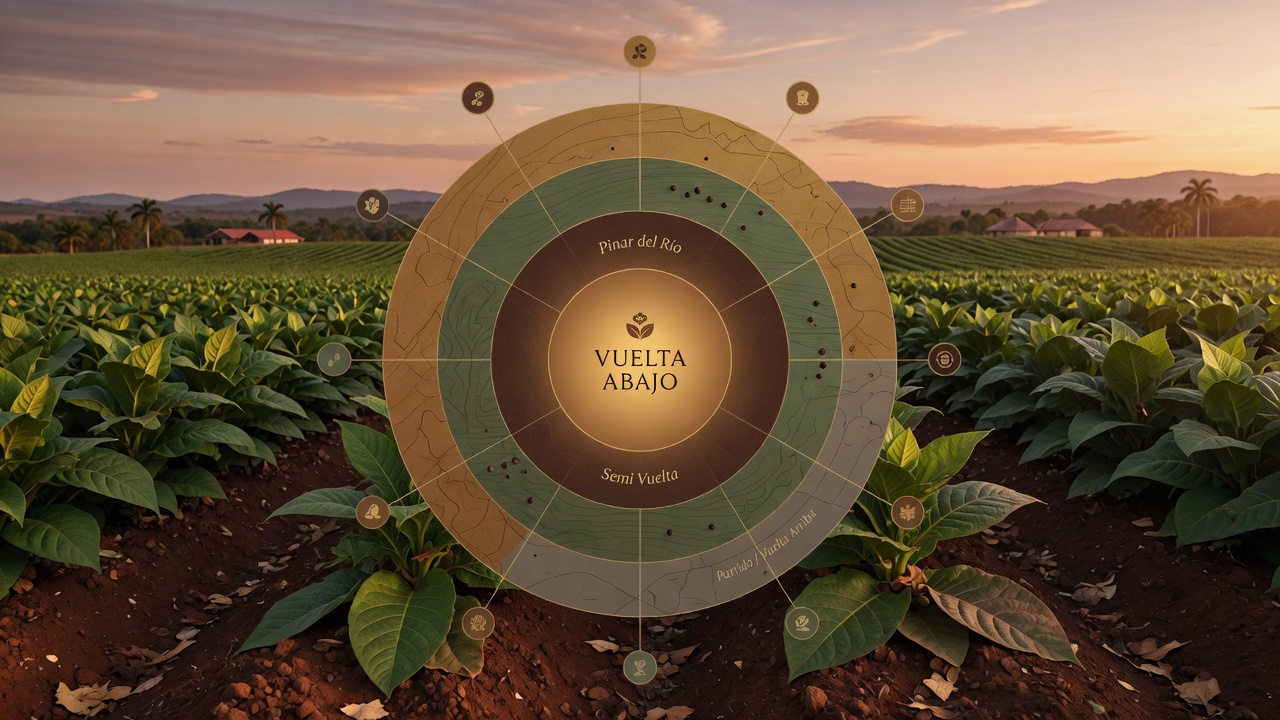
II. How terroir becomes “Cuban style”: a readable mechanism chain
Translating marketing language into mechanism helps later reading of the origin map.
1. Climate: wet–dry seasons, light and temperature, secondary metabolism
- The wet season supports biomass and leaf-area expansion; the dry season gives rhythm to ripening and processing windows. An island climate with a clear wet–dry split favors a predictable farm calendar.
- Warmth + high humidity support active growth; if nitrogen management runs high, the leaf easily moves toward higher alkaloid and irritation; managed well, one looks for a balance between “power” and “cleanness.”
- Light affects more than yield: strong sun versus shade growing markedly changes leaf thickness, oil and elasticity — this is the physiological reason shade wrappers (traditions such as tapado) exist: thinner, more even, more elastic cover leaves serve appearance and burn, not the power sought in filler.
2. Soil: nitrogen is the master switch of style; drainage decides whether it can be repeated
Soil does not directly “mix in a pepper note.” Through available nitrogen, potassium, chlorine, texture and drainage it rewrites root uptake and metabolic paths:
- High available nitrogen → nicotine and total nitrogen tend to rise, sugar–alkaloid ratio tends to unbalance → strength and irritation rise, sweetness and “cleanness” risk falling;
- Relatively coordinated potassium → more favorable potential for burn-related quality;
- High chlorine → poorer burn, off-note risk;
- Fine loam + good drainage → the structural condition repeatedly stressed for classic fine fields, good for root vitality and nutrient rhythm, not “perfume already in the dirt.”
Therefore style can split across aspects, terraces and plot management inside the same province — the scientific reason later texts insist that “Vuelta Abajo also has internal grades.”
3. Position: liga / seco / volado and “blend thinking”
Filler is often graded by burn, strength and aroma contribution (wording varies slightly by source; grasp the logic):
- Leaves nearer the top, thicker in body, stronger in strength and aroma often carry “power and main aroma”;
- Mid-plant often compromises between aroma and burn;
- Lower, thinner, better-burning leaves often “hold the base,” guaranteeing burn and airflow.
A cigar’s “Cuban feel” is largely the ratio of leaves of different positions and different fermentation degrees in the blend, not the single taste of one magical leaf. When reading an origin map, always stack “origin” with “position/use.”
4. Processing and aging: “freezing” and “rewriting” field precursors
Cuban cigar leaf follows an air-curing + multi-stage fermentation/aging path (unlike the intensive flue-curing logic of cigarette tobacco). The field forms the skeleton of sugars, nicotine, nitrogenous compounds, polyphenols and aroma precursors; the curing barn and fermentation room then, through temperature, humidity and time, drive off-notes down, rearrange the aroma spectrum and round the mouthfeel.
Key point: terroir offers possibility; processing decides the finally perceptible form. Same year, same field — if fermentation progress differs, the senses can judge two different objects. That is why a “vintage feel” is real, yet hard to summarize in one advertisement.
III. Flavor map of Cuba’s main origins
Below we unfold by prestige and raw-material importance. Chinese renderings of names vary; the text keeps common phonetic/semantic pairs.
1. Vuelta Abajo (Lower Vuelta): the center of the map
Location and ecological portrait
- Far west of Cuba, the core tobacco belt of Pinar del Río Province.
- The name most often mentioned in cigar culture; often linked with towns such as San Juan y Martínez, San Luis and nearby famous districts (specific plots and “reserve” narratives vary by literature and brand material).
- Consensus trade description: soil and microclimate combinations favor high-quality cigar leaf; can cover all uses — wrapper, binder, filler.
Representative style tendencies (trends)
| Dimension | Common description |
|---|---|
| Structure | Complete, with a backbone, strong satisfaction |
| Aroma type | Spice/pepper, wood, earth–mineral, leather, coffee/cocoa leanings |
| Strength | Medium to on the strong side (depends on blend and position; not “inevitably explosive”) |
| Mouthfeel | Many narratives of oiliness and complexity; fine lots seek power and delicacy together |
| Use | Full-type raw-material core in top-tier narratives |
How to read this origin
Treat Vuelta Abajo as the default origin point of the Cuban flavor map: later talk of another origin as “softer” or “stronger” is often, unconsciously, a contrast with here. But the origin point is not uniform — plot management, shade or not, harvest position will split “the same origin” into two stories: wrapper logic and filler logic.
2. Semi Vuelta (Half Vuelta): the “outer ring” of the core
Location and positioning
- Geographically near Vuelta Abajo, a secondary-ring narrative inside the western production pattern.
- In traditional grading talk it usually is not equated with Vuelta Abajo’s highest prestige, yet can still supply leaf of commercial and blend value.
Style and use tendencies
- Relative to the core, often described as a usable source whose power or delicacy is “one notch lower” (still a relative claim).
- Appears more in discussions of cost, yield and blend balance: not “unusable,” but “a different place on the pyramid.”
For readers: seeing “Semi Vuelta” should call up a gradient on the outer ring of the core origin, not a simple verdict of “worse.” Gradient awareness is where an origin map is more accurate than an advertisement.
3. Partido: an important chapter in wrapper tradition
Location and historical role
- In traditional tobacco-district narratives near Havana, Partido has long been repeatedly recorded as strong in wrapper / cover leaf.
- In cigar structure, wrapper carries very high weight for “first-puff impression, oily appearance, even burn,” so an origin “specialized in wrapper” means functional expertise on the map, not necessarily “lower” or “higher” than a filler origin.
Keys to reading style
- Wrapper seeks: suitable thickness, elasticity, oil, even color, burn-friendly behavior, contributing many surface and side notes in aroma.
- Measuring a wrapper origin by filler “strength standards” is a complete mismatch.
Partido reminds us: an origin map must be layered by use, or it becomes mere place-name collecting.
4. Vuelta Arriba and Remedios: another soil–climate script in the center
Location and ecology
- Vuelta Arriba (Upper Vuelta) is broadly associated with central Cuba and similar areas; among them the Remedios tobacco district is a node often named on its own.
- Soil and climate are not the same as the western core, so field physiology and reachable style range also shift — the weakest counter-example to “one taste for the whole island.”
Style and market narrative
- In trade materials, central leaf is often linked to specific brand positioning, more approachable or stylistically different lines (for example, “central raw material” wording is common in Jose L. Piedra narratives; actual blends follow official and vintage sources).
- Against Vuelta Abajo’s “rich structure” discourse, central leaf is more often placed on another value-and-style spectrum: perhaps more direct, with less “holy-grail halo,” yet still part of Cuba’s raw-material map.
How to read it
Treat Remedios / Vuelta Arriba as a second coordinate system on the map: proof that real origin differentiation exists inside Cuba, not only one western myth.
5. Other regions (brief table)
| Regional narrative | Place on the map | Reading hint |
|---|---|---|
| Western core (Vuelta Abajo) | Center | Full-type, high prestige, default reference of the style lexicon |
| Semi Vuelta | Outer ring | Gradient and blend balance |
| Partido | Wrapper-function pole | Read by use, not by “strength ranking” |
| Vuelta Arriba / Remedios | Central sub-center | Different soil–climate script, different market positioning |
| Farther east or other secondary origins | Edge / supplement | Yield and historical role change with the era; do not cut with old labels |
IV. Side-by-side: one table to read Cuban origins
Western core vs central sub-center
Vuelta Abajo
- Full-type raw-material narrative
- Spice-wood-earth lexicon
- Default map origin
Remedios / Vuelta Arriba
- Another soil-climate script
- Specific brands and broader lines
- Second coordinate system
| Origin | Climate–soil points (trend) | Typical use narrative | Flavor/style tendency (trend) | Role on the map |
|---|---|---|---|---|
| Vuelta Abajo | Tropical maritime, wet–dry seasons; fine well-drained loam narrative | Wrapper + binder + filler | Strong structure, spice-wood-earth, satisfaction | Center and default reference |
| Semi Vuelta | Near the core, different micro-habitats | Blend and yield supplement | Gradient down from the core (relatively) | Outer ring |
| Partido | Historic wrapper-origin narrative | Strong in wrapper / cover leaf | Stresses appearance, burn and surface-aroma contribution | Function-specialist pole |
| Vuelta Arriba / Remedios | Different central soil and climate | Specific brands and broader product lines | Another spectrum; do not force the western lexicon | Sub-center |
One more cross-use reminder:
| Use | What you should care about more | Common misread |
|---|---|---|
| Wrapper | Elasticity, color, oil, burn, surface aroma | Measuring “good or not” by strength |
| Binder | Toughness, burn assist, structure | Ignoring its existence entirely |
| Filler | Position ratio, strength, main aroma, off-note control | Thinking one leaf decides the whole stick |
V. How to read a “Cuban narrative” (an appreciation frame, not a use guide)
If you meet the words “Cuban origin” in a review, museum note or brand story, the list below quickly locates information density — this is a cultural and raw-material reading frame, not an encouragement to try tobacco products.
- Does it name the Vuelta Abajo level, or only write “Cuba”?
Writing only the country name carries about as much information as writing only “French wine.”
- Does it distinguish wrapper / filler sources?
Same-origin full-type leaf versus a mixed-origin blend are two different stories.
- Does it give vintage, strength and aroma-type keywords?
“Earth, pepper, coffee, wood, cocoa” is lexicon; “sacred and irreplaceable” is rhetoric.
- Does it admit fermentation and aging?
When what you read is a narrative of “roundness/irritation,” process is often as important as origin.
- Does it state health risks?
Responsible content should avoid swapping origin prestige for “quality = lower harm.”
One-line hooks to non-Cuban origins (for later pieces in the series):
- Dominican Republic: often contrasted as a rounder, sweeter, more approachable spectrum (Cibao / Yaque and other valley narratives).
- Nicaragua: often contrasted as a spectrum of power, pepper and prominent earth.
These contrasts help build relative coordinates; they are not a national ranking contest.
VI. Common misconceptions
Misconception 1: “Cuba is always the punchiest, the strongest”
No. Strength comes first from filler position ratio, fermentation degree and stick size, and only then from origin trend. There are narratives of strong structure with fine layering, and also expressions “held down” by the blend. Equating a country name directly with a strength grade is a lazy label.
Misconception 2: “The whole island of Cuba tastes the same”
No. Soil, climate and market positioning of Vuelta Abajo and Remedios are already different; stack wrapper vs filler and the spectrum is wide. “One taste” exists only in tourist copy.
Misconception 3: “Origin = quality guarantee = always worth a premium”
An origin offers probability and traditional advantage, not quality insurance for every leaf. Vintage, pests, harvest and processing mistakes can make a star origin hand in a mediocre paper; excellent farms and factories in other countries can also finish products at a very high level. Premiums often contain prestige, scarcity, tax and channel, not only agricultural metrics.
Misconception 4: “The soil itself contains pepper / mineral taste”
Sensory “earth, mineral, pepper” is the result of combined metabolism + processing + combustion products + cognitive expectation. Soil shapes the chemical spectrum indirectly through nutrients and water, but does not dissolve pepper powder into roots. Literary rhetoric is allowed; do not overfill the causality.
Misconception 5: “Knowing origins lets you pick a safer smoke”
Any combusted tobacco product has clear health risks. Origin knowledge helps you see through marketing talk and understand raw-material differences; it does not lower disease risk, nor does it constitute consumption advice.
VII. Health note and stance
- Tobacco smoke contains nicotine (highly addictive) and large amounts of harmful and potentially carcinogenic substances; cigars and cigarettes both produce harmful smoke in the essence of combustion.
- “Handmade,” “origin legend” and “aged” do not equal harm reduction.
- If you already use tobacco or nicotine products and wish to reduce or stop, seek evidence-based cessation methods and advice from medical professionals; this series does not provide how-to guides that encourage use.
This series talks origins so that, inside information-overloaded tobacco-culture content, readers keep structure and judgment: what is terroir, what is process, what is brand myth.
VIII. Close and series preview
The unique status of Cuban tobacco is stacked on three things:
- The long narrative of the western core (especially Vuelta Abajo) in ecology and full-type raw-material capability;
- A complete cigar raw-material language formed by position grading + air-curing and fermentation tradition;
- Historical institutions and global prestige that symbolize the two points above as “orthodoxy.”
Understand these three and you have the origin point of the flavor map:
not the slogan “Cuba is best,” but the method of “how to take one place apart into climate, soil, use, process and market prestige.”
Next stop we will push the same method toward other coordinates — for example the Dominican valley’s supple spectrum, Central America’s power spectrum, and Asia and South America’s different scripts in flue-cured / cigar raw material — so the “flavor map” truly becomes a tool for comparison, not a string of place names.
This article is raw-material and origin popular science; it does not constitute purchase or use advice for any tobacco product.